Go-03-Groutine

创建一个协程

1
go func()//通过go关键字启动一个协程来运行函数

那么它到底干了什么

1
2
3
4
5
6
7
8
9
10
11
12
13
14
15
func newproc(siz int32, fn *funcval) {
argp := add(unsafe.Pointer(&fn), sys.PtrSize)
gp := getg()
pc := getcallerpc()
systemstack(func() {
newg := newproc1(fn, argp, siz, gp, pc)

_p_ := getg().m.p.ptr()
runqput(_p_, newg, true)

if mainStarted {
wakep()
}
})
}

关键术语

并发:一个cpu上能同时执行多项任务,在很短时间内,cpu来回切换任务执行(在某段很短时间内执行程序a,然后又迅速得切换到程序b去执行),有时间上的重叠(宏观上是同时的,微观仍是顺序执行),这样看起来多个任务像是同时执行,这就是并发

并行:当系统有多个CPU时,每个CPU同一时刻都运行任务,互不抢占自己所在的CPU资源,同时进行,称为并行

进程:cpu在切换程序的时候,如果不保存上一个程序的状态(也就是context–上下文),直接切换下一个程序,就会丢失上一个程序的一系列状态,于是引入了进程这个概念,用以划分好程序运行时所需要的资源。因此进程就是一个程序运行时候的所需要的基本资源单位(也可以说是程序运行的一个实体)

线程:cpu切换多个进程的时候,会花费不少的时间,因为切换进程需要切换到内核态,而每次调度需要内核态都需要读取用户态的数据,进程一旦多起来,cpu调度会消耗一大堆资源,因此引入了线程的概念,线程本身几乎不占有资源,他们共享进程里的资源,内核调度起来不会那么像进程切换那么耗费资源

协程:协程拥有自己的寄存器上下文和栈。

协程与线程

goroutine与thread的不同

  1. 内存占用
  • 一个 goroutine 的栈内存消耗为 2 KB(如果栈空间不够用,会自动进行扩容)。
  • 一个 thread 则需要消耗 1 MB 栈内存,还需要一个被称为 “a guard page” 的区域(用于与其他thread隔离)
  1. 创建和销毀
  • goroutine的切换会消耗200ns(用户态,3个寄存器),相当于2400-3600条指令

  • 除了使用时需要陷入内核,线程切换会消耗1000-1500ns

    1. 1ns平均可执行12-18条指令

当 threads 切换时,需要保存各种寄存器,以便将来恢复:

  • 16 general purpose registers: 通用寄存器
  • PC (Program Counter): 程序计数器
  • SP (Stack Pointer): 栈指针
  • segment registers: 段寄存器
  • 16 XMM registers:
  • FP coprocessor state
  • 16 AVX registers
  • all MSRs etc

而 goroutines 切换只需保存三个寄存器

  • Program Counter
  • Stack Pointer
  • BP:基址指针寄存器,常用于在访问内存时存放内存单元的偏移地址

Thread内存堆栈
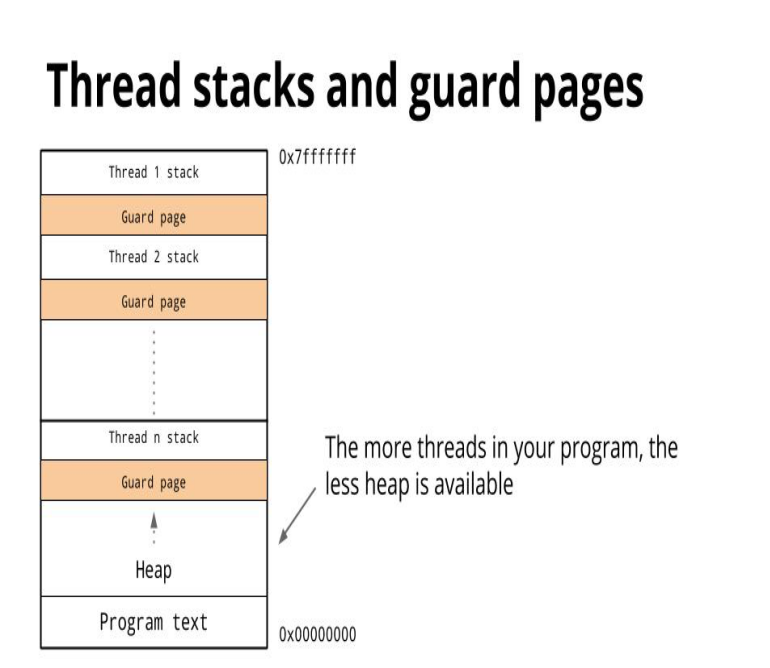
image-20211228233024460

创建一个 thread 为了尽量避免极端情况下操作系统线程栈的溢出,默认会为其分配一个较大的栈内存( 1 - 8 MB 栈内存,线程标准 POSIX Thread),而且还需要一个被称为 guard page 的区域用于和其他 thread 的栈空间进行隔离。而栈内存空间一旦创建和初始化完成之后其大小就不能再有变化,这决定了在某些特殊场景下系统线程栈还是有溢出的风险

调度模型

Go 程序的执行由两层组成:Go Program,Runtime(即用户程序和运行时)
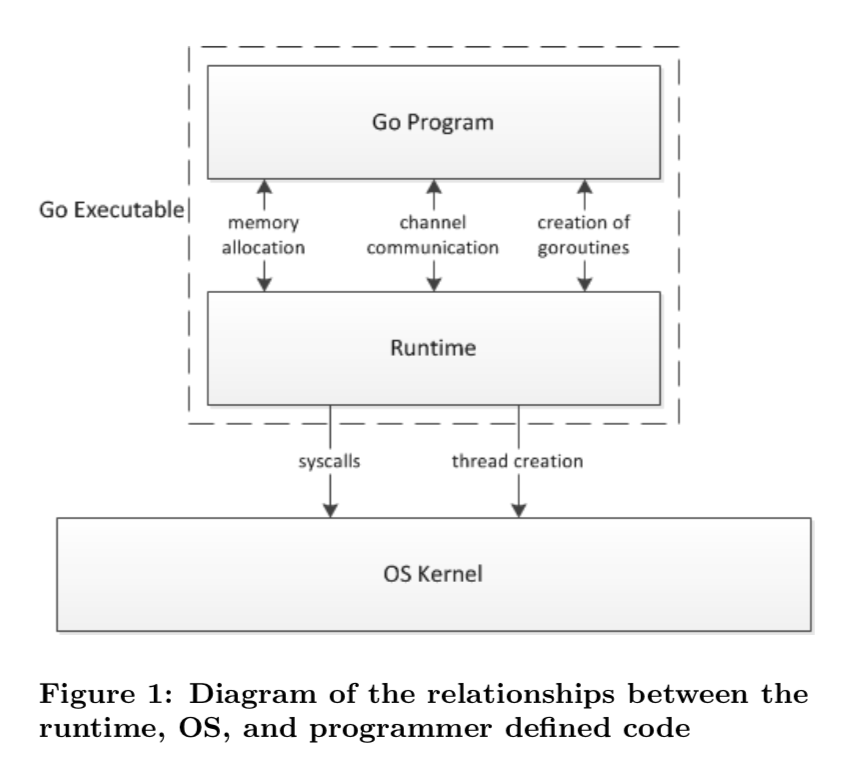
Go创建M个线程(CPU执行调度的单元,内核的task_struck),之后创建N个goroutine会依附在M个线程上执行即M:N模型。当M指定了线程栈,则M.stack->G.stack,M的PC寄存器指向G提供的函数,然后执行

GMP

Go的调度器内部有四个重要的结构:M,P,G,Sched

  1. M:M代表内核级线程,一个M就是一个线程,goroutine就是跑在M之上的;M是一个很大的结构,里面维护小对象内存cache(mcache)、当前执行的goroutine、随机数发生器等等非常多的信息
  2. G:代表一个goroutine,它有自己的栈,instruction pointer和其他信息(正在等待的channel等等),用于调度。
  3. P:代表一个Processor(Core 虚拟处理器),它的主要用途就是用来执行goroutine的,维护了一个需要执行goroutine的队列(LRQ Local Run Queue)
  4. Sched:代表调度器,它维护有存储M和G的队列以及调度器的一些状态信息等

LRQ:本地运行队列,它属于每个处理器,以便管理分配给要执行的goroutines

GRQ:全局运行队列,存在于未分配的goroutine中

下面四种情形下,Go scheduler有机会进行调度

  1. 使用关键字go: go创建一个新的goroutine, Go scheduler 会考虑调度
  2. GC: 由于进行 GC 的 goroutine 也需要在 M 上运行,因此肯定会发生调度。当然,Go scheduler 还会做很多其他的调度,例如调度不涉及堆访问的 goroutine 来运行。GC 不管栈上的内存,只会回收堆上的内存
  3. 系统调用:当 goroutine 进行系统调用时,会阻塞 M,所以它会被调度走,同时一个新的 goroutine 会被调度上来
  4. 内存同步访问:atomic,mutex,channel 操作等会使 goroutine 阻塞,因此会被调度走。等条件满足后(例如其他 goroutine 解锁了)还会被调度上来继续运行
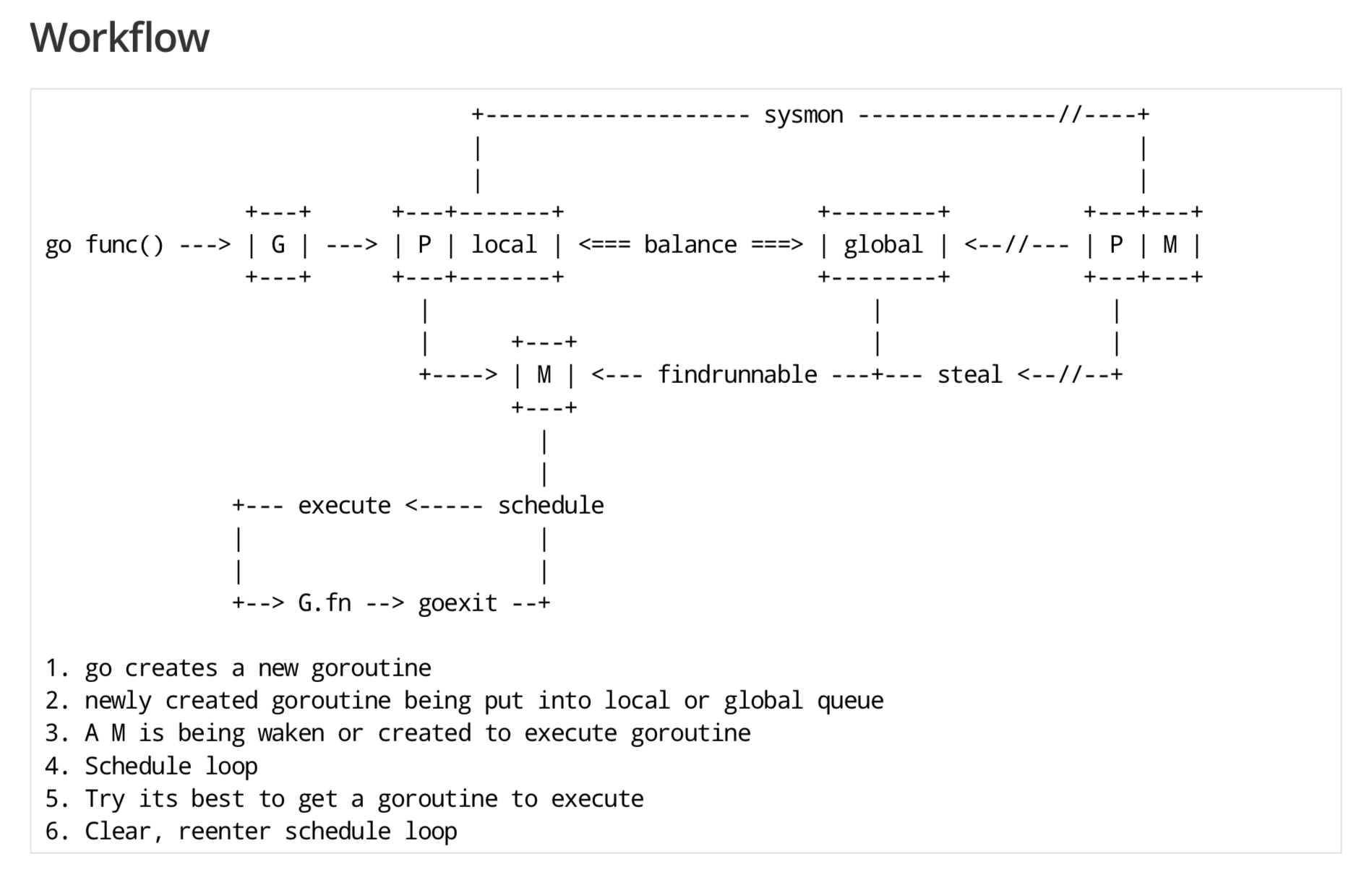
goroutine workflow

M:N 模型

Go runtime 会负责 goroutine 的生老病死,从创建到销毁。Runtime 会在程序启动的时候,创建 M 个线程(CPU 执行调度的单位),之后创建的 N 个 goroutine 都会依附在这 M 个线程上执行。这就是 M:N 模型:
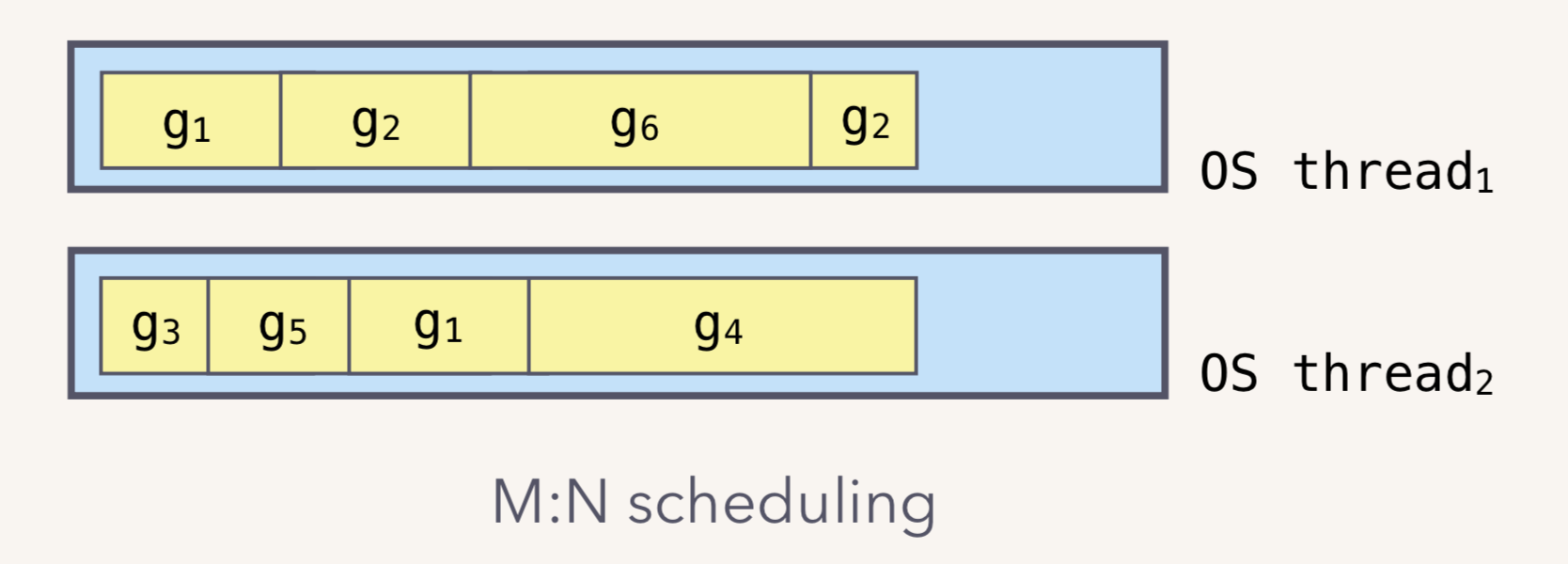
M:N scheduling

在同一时刻,一个线程上只能跑一个 goroutine。当 goroutine 发生阻塞(例如向一个 channel 发送数据,被阻塞)时,runtime 会把当前 goroutine 调度走,让其他 goroutine 来执行。目的就是不让一个线程闲着,榨干 CPU 的每一滴油水

工作窃取

Go scheduler 的职责就是将所有处于 runnable 的 goroutines 均匀分布到在 P 上运行的 M。当一个 P 发现自己的 LRQ 已经没有 G 时,会从其他 P “偷” 一些 G 来运行。这被称为 Work-stealing

Go scheduler 使用 M:N 模型,在任一时刻,M 个 goroutines(G) 要分配到 N 个内核线程(M),这些 M 跑在个数最多为 GOMAXPROCS 的逻辑处理器(P)上。每个 M 必须依附于一个 P,每个 P 在同一时刻只能运行一个 M。如果 P 上的 M 阻塞了,那它就需要其他的 M 来运行 P 的 LRQ 里的 goroutines
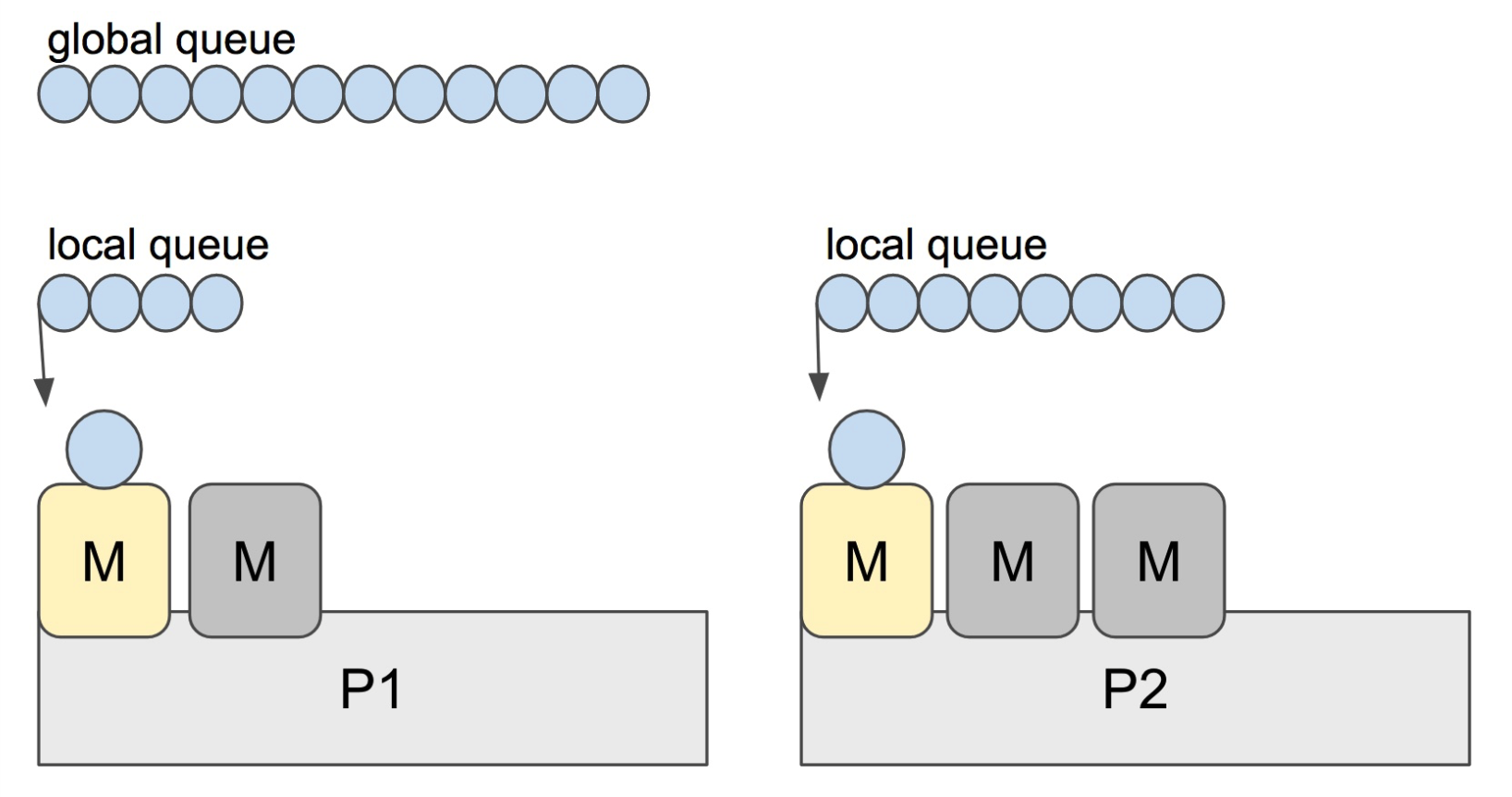
GPM relatioship

Go scheduler 每一轮调度要做的工作就是找到处于 runnable 的 goroutines,并执行它。找的顺序如下:

1
2
3
4
5
6
7
8
runtime.schedule() { 
// only 1/61 of the time, check the global runnable queue for a G.
// if not found, check the local queue.
// if not found,
// try to steal from other Ps.
// if not, check the global runnable queue.
// if not found, poll network.
}

找到一个可执行的 goroutine 后,就会一直执行下去,直到被阻塞

当 P2 上的一个 G 执行结束,就会去 LRQ 获取下一个 G 来执行。如果 LRQ 已经空了,就是说本地可运行队列已经没有 G 需要执行,并且这时 GRQ 也没有 G 了。这时,P2 会随机选择一个 P(称为 P1),P2 会从 P1 的 LRQ “偷”过来一半的 G
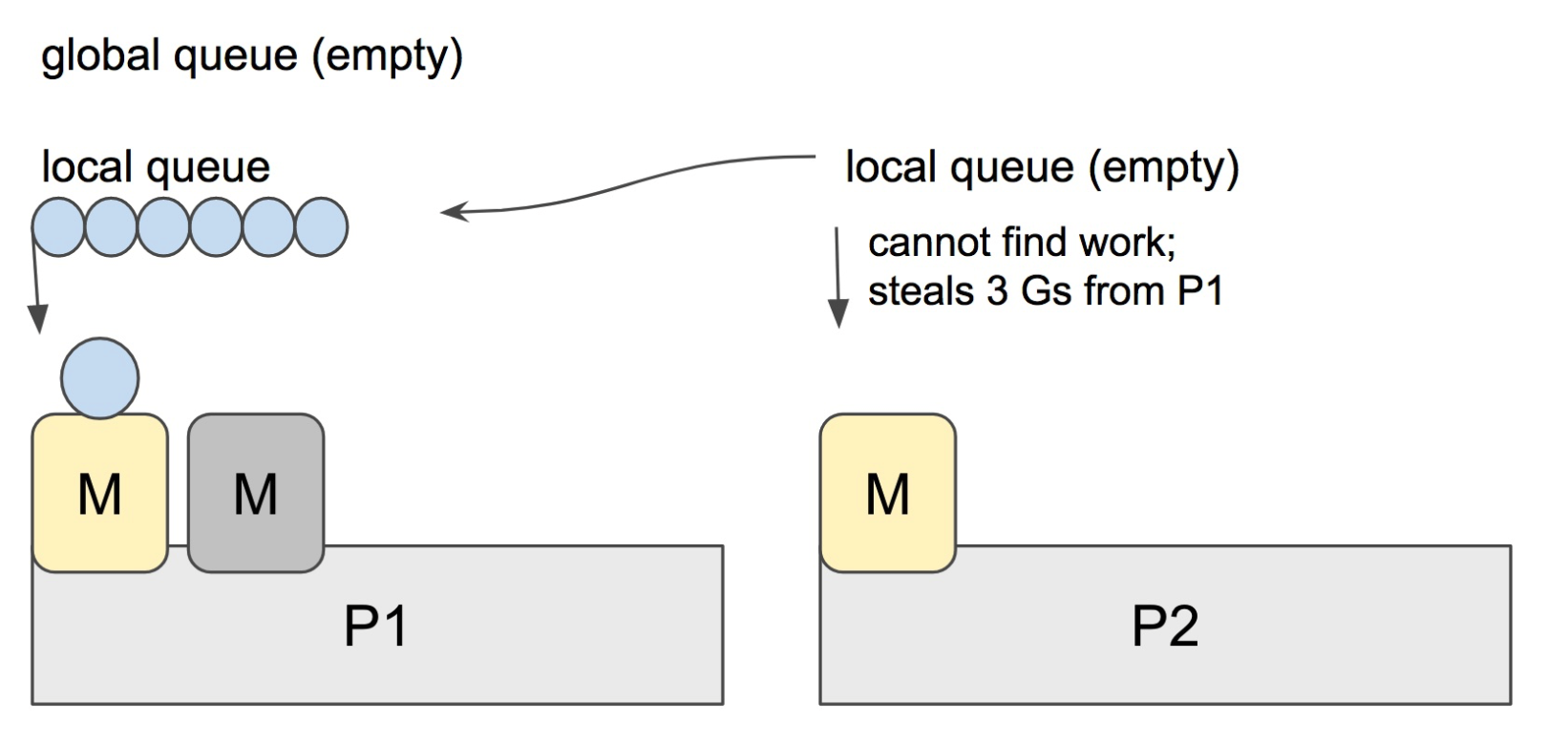
Work Stealing

状态切换

GPM 共同成就 Go scheduler。G 需要在 M 上才能运行,M 依赖 P 提供的资源,P 则持有待运行的 G。
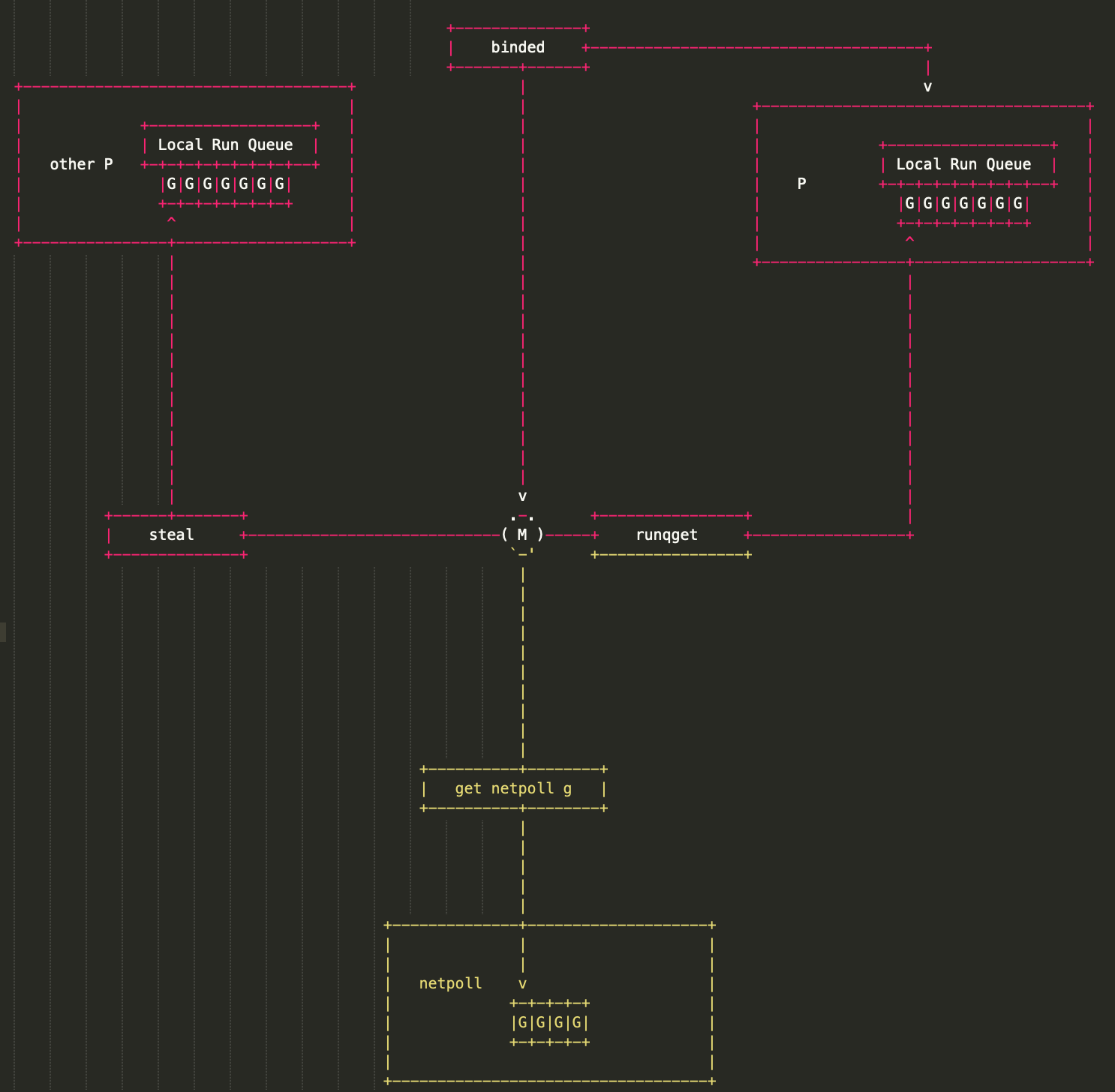
曹大 golang notes GPM 三者关系

M 会从与它绑定的 P 的本地队列获取可运行的 G,也会从 network poller 里获取可运行的 G,还会从其他 P 偷 G

G 的状态流转:
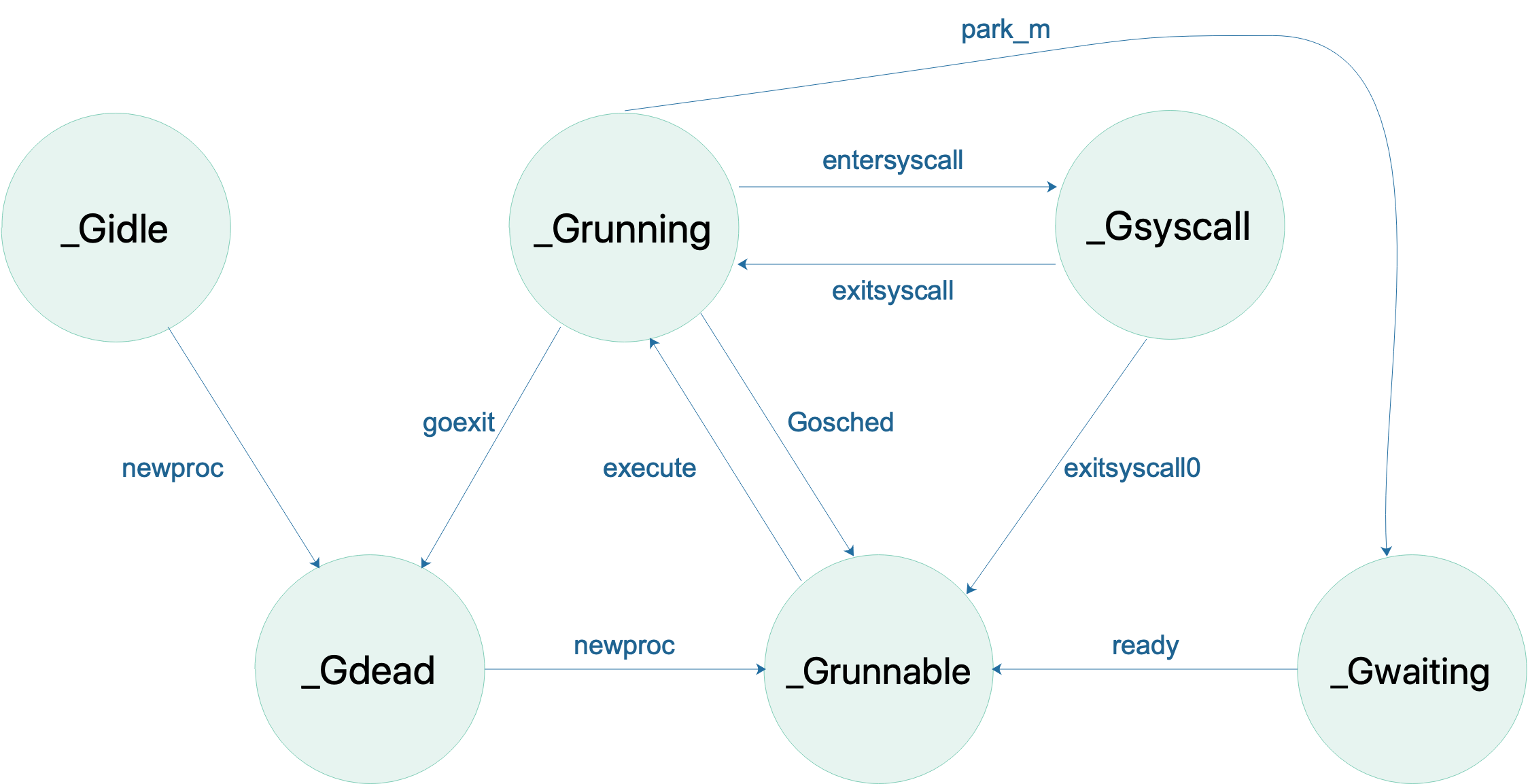
G 的状态流转图

省略了一些垃圾回收的状态

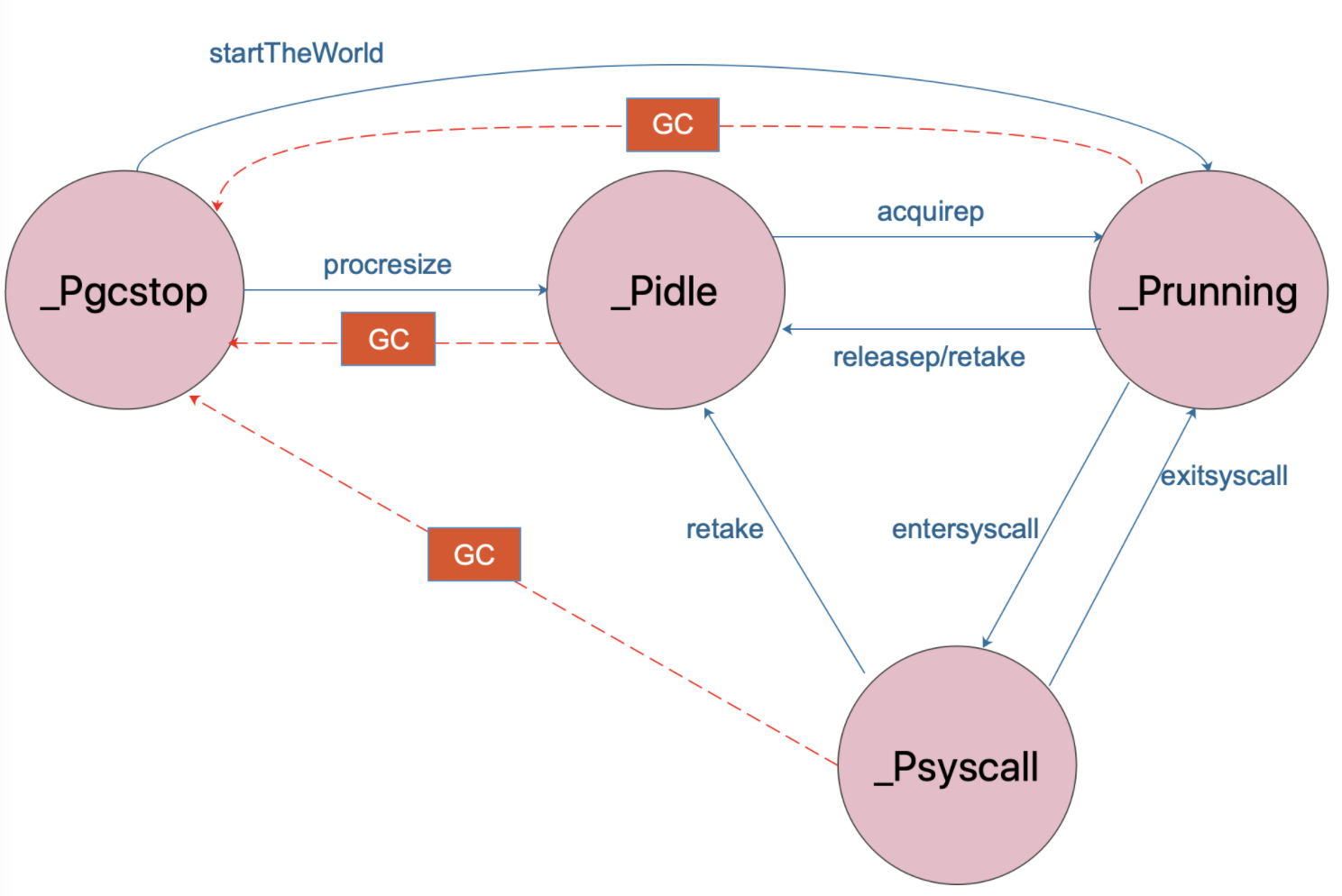
P 的状态流转:

image-20210814143145689 image-20210814143145689

通常情况下(在程序运行时不调整 P 的个数),P 只会在上图中的四种状态下进行切换。

当程序刚开始运行进行初始化时,所有的 P 都处于 _Pgcstop 状态, 随着 P 的初始化(runtime.procresize),会被置于 _Pidle

当 M 需要运行时,会 runtime.acquirep 来使 P 变成 Prunning 状态,并通过 runtime.releasep 来释放。

当 G 执行时需要进入系统调用,P 会被设置为 _Psyscall, 如果这个时候被系统监控抢夺(runtime.retake),则 P 会被重新修改为 _Pidle

如果在程序运行中发生 GC,则 P 会被设置为 _Pgcstop, 并在 runtime.startTheWorld 时重新调整为 _Prunning

M 的状态变化:
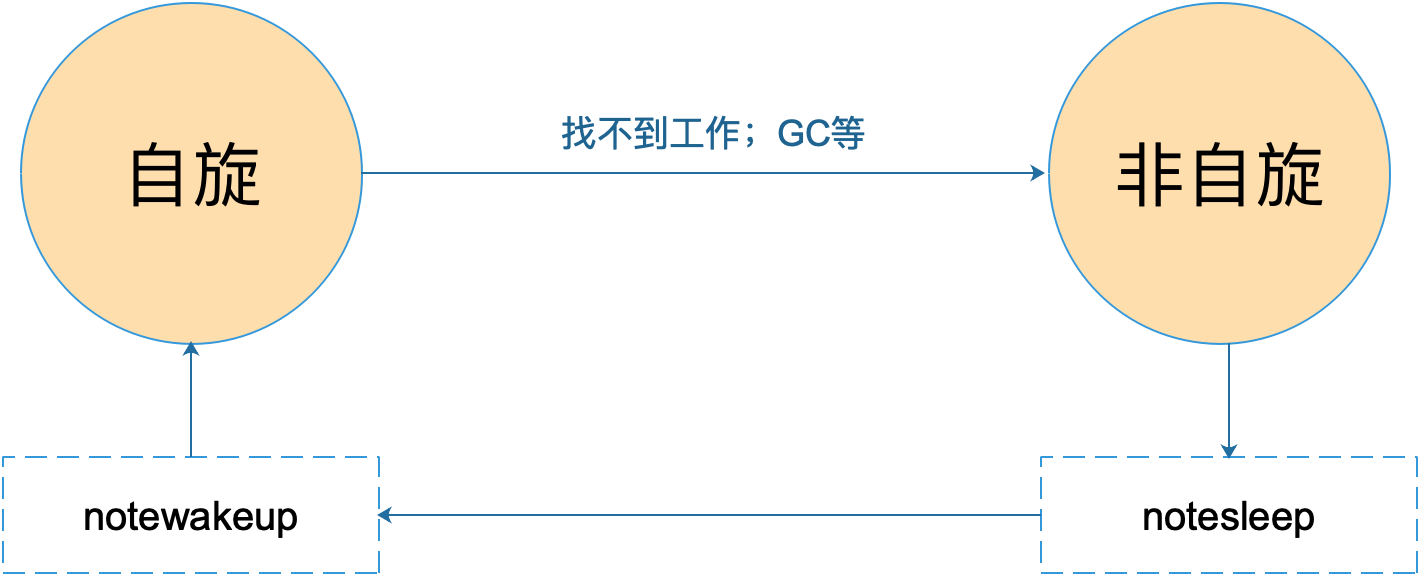
M 的状态流转图

M 只有自旋和非自旋两种状态。自旋的时候,会努力找工作;找不到的时候会进入非自旋状态,之后会休眠,直到有工作需要处理时,被其他工作线程唤醒,又进入自旋状态

调度器

Go调度程序不是抢占式调度程序,而是协作式调度程序。 成为协作调度程序意味着调度程序需要在代码的安全点明确定义用户空间事件,以制定调度决策。 以下是调度的关键点:

  1. 启动协程的关键字go

  2. 垃圾回收GC

  3. 系统调用

    • 对于异步系统调用例如网络请求,将可能阻止的goroutine移到网络轮询器,让处理程序可以执行下一个
    • 处理像文件IO同步请求,当前的G和M对将与G,P,M模型分开。 同时,将创建一台新机器,以保持原始的G,P,M模型正常工作,并且在系统调用完成时将收回块goroutine

img

地鼠(gopher)用小车运着一堆待加工的砖。M就可以看作图中的地鼠,P就是小车,G就是小车里装的砖。一图胜千言啊,弄清楚了它们三者的关系,下面我们就开始重点聊地鼠是如何在搬运砖块的

启动过程
  1. runtime·schedinit 调度器初始化:主要是根据用户设置的GOMAXPROCS来创建一批小车(P),不管设置多大,最多也只能创建256个小车(P)。这些小车(p)初始创建好后都是闲置状态,也就是还没开始使用,所以它们都放置在调度器结构(Sched)的pidle字段维护的链表中存储起来了,以备后续之需。
  2. runtime.newproc 创建一个协程
  3. runtime.main
  4. runtime·mstart

源码阅读

G
1
2
3
4
5
6
7
8
9
10
11
12
13
14
15
16
17
18
19
20
21
22
23
24
25
26
27
28
29
30
31
32
33
34
35
36
37
38
39
40
41
42
43
44
45
46
47
48
49
50
51
52
53
54
55
56
57
58
59
60
61
62
63
64
65
66
67
68
69
70
71
72
73
74
75
76
77
78
79
80
81
82
83
84
85
86
87
88
89
90
type g struct {
// goroutine 使用的栈
stack stack // offset known to runtime/cgo
// 用于栈的扩张和收缩检查,抢占标志
stackguard0 uintptr // offset known to liblink
stackguard1 uintptr // offset known to liblink

_panic *_panic // innermost panic - offset known to liblink
_defer *_defer // innermost defer
//当前与g 绑定的 m
m *m // current m; offset known to arm liblink
// goroutine 的运行现场
sched gobuf
syscallsp uintptr // if status==Gsyscall, syscallsp = sched.sp to use during gc
syscallpc uintptr // if status==Gsyscall, syscallpc = sched.pc to use during gc
stktopsp uintptr // expected sp at top of stack, to check in traceback
// wakeup 时传入的参数
param unsafe.Pointer
atomicstatus uint32
stackLock uint32 // sigprof/scang lock; TODO: fold in to atomicstatus
goid int64
schedlink guintptr
// g 被阻塞之后的近似时间
waitsince int64 // approx time when the g become blocked
// g 被阻塞的原因
waitreason waitReason // if status==Gwaiting
// 抢占调度标志。这个为 true 时,stackguard0 等于 stackpreempt
preempt bool // preemption signal, duplicates stackguard0 = stackpreempt
preemptStop bool // transition to _Gpreempted on preemption; otherwise, just deschedule
preemptShrink bool // shrink stack at synchronous safe point

// asyncSafePoint is set if g is stopped at an asynchronous
// safe point. This means there are frames on the stack
// without precise pointer information.
asyncSafePoint bool

paniconfault bool // panic (instead of crash) on unexpected fault address
gcscandone bool // g has scanned stack; protected by _Gscan bit in status
throwsplit bool // must not split stack
// activeStackChans indicates that there are unlocked channels
// pointing into this goroutine's stack. If true, stack
// copying needs to acquire channel locks to protect these
// areas of the stack.
activeStackChans bool
// parkingOnChan indicates that the goroutine is about to
// park on a chansend or chanrecv. Used to signal an unsafe point
// for stack shrinking. It's a boolean value, but is updated atomically.
parkingOnChan uint8

raceignore int8 // ignore race detection events
sysblocktraced bool // StartTrace has emitted EvGoInSyscall about this goroutine
tracking bool // whether we're tracking this G for sched latency statistics
trackingSeq uint8 // used to decide whether to track this G
runnableStamp int64 // timestamp of when the G last became runnable, only used when tracking
runnableTime int64 // the amount of time spent runnable, cleared when running, only used when tracking
// syscall 返回之后的 cputicks,用来做 tracing
sysexitticks int64 // cputicks when syscall has returned (for tracing)
traceseq uint64 // trace event sequencer
tracelastp puintptr // last P emitted an event for this goroutine
// 如果调用了 LockOsThread,那么这个 g 会绑定到某个 m 上
lockedm muintptr
sig uint32
writebuf []byte
sigcode0 uintptr
sigcode1 uintptr
sigpc uintptr
// 创建该 goroutine 的语句的指令地址
gopc uintptr // pc of go statement that created this goroutine
ancestors *[]ancestorInfo // ancestor information goroutine(s) that created this goroutine (only used if debug.tracebackancestors)
// goroutine 函数的指令地址
startpc uintptr // pc of goroutine function
racectx uintptr
waiting *sudog // sudog structures this g is waiting on (that have a valid elem ptr); in lock order
cgoCtxt []uintptr // cgo traceback context
labels unsafe.Pointer // profiler labels
// time.Sleep 缓存的定时器
timer *timer // cached timer for time.Sleep
selectDone uint32 // are we participating in a select and did someone win the race?

// Per-G GC state

// gcAssistBytes is this G's GC assist credit in terms of
// bytes allocated. If this is positive, then the G has credit
// to allocate gcAssistBytes bytes without assisting. If this
// is negative, then the G must correct this by performing
// scan work. We track this in bytes to make it fast to update
// and check for debt in the malloc hot path. The assist ratio
// determines how this corresponds to scan work debt.
gcAssistBytes int64
}

其中g结构体关联了两个比较简单的结构体,stack 表示 goroutine 运行时的栈

1
2
3
4
5
6
7
8
9
10
11
12
13
14
15
16
17
18
19
20
21
// 描述栈的数据结构,栈的范围:[lo, hi)
type stack struct {
// 栈顶,低地址
lo uintptr
// 栈低,高地址
hi uintptr
}

type gobuf struct {
// 存储 rsp 寄存器的值
sp uintptr
// 存储 rip 寄存器的值
pc uintptr
// 指向 goroutine
g guintptr
ctxt unsafe.Pointer // this has to be a pointer so that gc scans it
// 保存系统调用的返回值
ret sys.Uintreg
lr uintptr
bp uintptr // for GOEXPERIMENT=framepointer
}
M

再来看 M,取 machine 的首字母,它代表一个工作线程,或者说系统线程。G 需要调度到 M 上才能运行,M 是真正工作的人。结构体 m 就是我们常说的 M,它保存了 M 自身使用的栈信息、当前正在 M 上执行的 G 信息、与之绑定的 P 信息……

当 M 没有工作可做的时候,在它休眠前,会“自旋”地来找工作:检查全局队列,查看 network poller,试图执行 gc 任务,或者“偷”工作

1
2
3
4
5
6
7
8
9
10
11
12
13
14
15
16
17
18
19
20
21
22
23
24
25
26
27
28
29
30
31
32
33
34
35
36
37
38
39
40
41
42
43
44
45
46
47
48
49
50
51
52
53
54
55
56
57
58
59
60
61
62
63
64
65
66
67
68
69
70
71
72
73
74
75
76
77
78
79
80
81
82
83
84
85
86
87
88
89
90
91
92
93
94
95
// m 代表工作线程,保存了自身使用的栈信息
type m struct {
// 记录工作线程(也就是内核线程)使用的栈信息。在执行调度代码时需要使用
// 执行用户 goroutine 代码时,使用用户 goroutine 自己的栈,因此调度时会发生栈的切换
g0 *g // goroutine with scheduling stack
morebuf gobuf // gobuf arg to morestack
divmod uint32 // div/mod denominator for arm - known to liblink

// Fields not known to debuggers.
procid uint64 // for debuggers, but offset not hard-coded
gsignal *g // signal-handling g
goSigStack gsignalStack // Go-allocated signal handling stack
sigmask sigset // storage for saved signal mask
tls [tlsSlots]uintptr // thread-local storage (for x86 extern register)
mstartfn func()
curg *g // current running goroutine
caughtsig guintptr // goroutine running during fatal signal
p puintptr // attached p for executing go code (nil if not executing go code)
nextp puintptr
oldp puintptr // the p that was attached before executing a syscall
id int64
mallocing int32
throwing int32
preemptoff string // if != "", keep curg running on this m
locks int32
dying int32
profilehz int32
spinning bool // m is out of work and is actively looking for work
blocked bool // m is blocked on a note
newSigstack bool // minit on C thread called sigaltstack
printlock int8
incgo bool // m is executing a cgo call
freeWait uint32 // if == 0, safe to free g0 and delete m (atomic)
fastrand [2]uint32
needextram bool
traceback uint8
ncgocall uint64 // number of cgo calls in total
ncgo int32 // number of cgo calls currently in progress
cgoCallersUse uint32 // if non-zero, cgoCallers in use temporarily
cgoCallers *cgoCallers // cgo traceback if crashing in cgo call
doesPark bool // non-P running threads: sysmon and newmHandoff never use .park
park note
alllink *m // on allm
schedlink muintptr
lockedg guintptr
createstack [32]uintptr // stack that created this thread.
lockedExt uint32 // tracking for external LockOSThread
lockedInt uint32 // tracking for internal lockOSThread
nextwaitm muintptr // next m waiting for lock
waitunlockf func(*g, unsafe.Pointer) bool
waitlock unsafe.Pointer
waittraceev byte
waittraceskip int
startingtrace bool
syscalltick uint32
freelink *m // on sched.freem

// mFixup is used to synchronize OS related m state
// (credentials etc) use mutex to access. To avoid deadlocks
// an atomic.Load() of used being zero in mDoFixupFn()
// guarantees fn is nil.
mFixup struct {
lock mutex
used uint32
fn func(bool) bool
}

// these are here because they are too large to be on the stack
// of low-level NOSPLIT functions.
libcall libcall
libcallpc uintptr // for cpu profiler
libcallsp uintptr
libcallg guintptr
syscall libcall // stores syscall parameters on windows

vdsoSP uintptr // SP for traceback while in VDSO call (0 if not in call)
vdsoPC uintptr // PC for traceback while in VDSO call

// preemptGen counts the number of completed preemption
// signals. This is used to detect when a preemption is
// requested, but fails. Accessed atomically.
preemptGen uint32

// Whether this is a pending preemption signal on this M.
// Accessed atomically.
signalPending uint32

dlogPerM

mOS

// Up to 10 locks held by this m, maintained by the lock ranking code.
locksHeldLen int
locksHeld [10]heldLockInfo
}
P
1
2
3
4
5
6
7
8
9
10
11
12
13
14
15
16
17
18
19
20
21
22
23
24
25
26
27
28
29
30
31
32
33
34
35
36
37
38
39
40
41
42
43
44
45
46
47
48
49
50
51
52
53
54
55
56
57
58
59
60
61
62
63
64
65
66
67
68
69
70
71
72
73
74
75
76
77
78
79
80
81
82
83
84
85
86
87
88
89
90
91
92
93
94
95
96
97
98
99
100
101
102
103
104
105
106
107
108
109
110
111
112
113
114
115
116
117
118
119
120
121
122
123
124
125
126
127
128
129
130
131
132
133
134
135
136
137
138
139
140
type p struct {
id int32
status uint32 // one of pidle/prunning/...
link puintptr
schedtick uint32 // incremented on every scheduler call
syscalltick uint32 // incremented on every system call
sysmontick sysmontick // last tick observed by sysmon
m muintptr // back-link to associated m (nil if idle)
mcache *mcache
pcache pageCache
raceprocctx uintptr

deferpool [5][]*_defer // pool of available defer structs of different sizes (see panic.go)
deferpoolbuf [5][32]*_defer

// Cache of goroutine ids, amortizes accesses to runtime·sched.goidgen.
goidcache uint64
goidcacheend uint64

// Queue of runnable goroutines. Accessed without lock.
runqhead uint32
runqtail uint32
runq [256]guintptr
// runnext, if non-nil, is a runnable G that was ready'd by
// the current G and should be run next instead of what's in
// runq if there's time remaining in the running G's time
// slice. It will inherit the time left in the current time
// slice. If a set of goroutines is locked in a
// communicate-and-wait pattern, this schedules that set as a
// unit and eliminates the (potentially large) scheduling
// latency that otherwise arises from adding the ready'd
// goroutines to the end of the run queue.
//
// Note that while other P's may atomically CAS this to zero,
// only the owner P can CAS it to a valid G.
runnext guintptr

// Available G's (status == Gdead)
gFree struct {
gList
n int32
}

sudogcache []*sudog
sudogbuf [128]*sudog

// Cache of mspan objects from the heap.
mspancache struct {
// We need an explicit length here because this field is used
// in allocation codepaths where write barriers are not allowed,
// and eliminating the write barrier/keeping it eliminated from
// slice updates is tricky, moreso than just managing the length
// ourselves.
len int
buf [128]*mspan
}

tracebuf traceBufPtr

// traceSweep indicates the sweep events should be traced.
// This is used to defer the sweep start event until a span
// has actually been swept.
traceSweep bool
// traceSwept and traceReclaimed track the number of bytes
// swept and reclaimed by sweeping in the current sweep loop.
traceSwept, traceReclaimed uintptr

palloc persistentAlloc // per-P to avoid mutex

_ uint32 // Alignment for atomic fields below

// The when field of the first entry on the timer heap.
// This is updated using atomic functions.
// This is 0 if the timer heap is empty.
timer0When uint64

// The earliest known nextwhen field of a timer with
// timerModifiedEarlier status. Because the timer may have been
// modified again, there need not be any timer with this value.
// This is updated using atomic functions.
// This is 0 if there are no timerModifiedEarlier timers.
timerModifiedEarliest uint64

// Per-P GC state
gcAssistTime int64 // Nanoseconds in assistAlloc
gcFractionalMarkTime int64 // Nanoseconds in fractional mark worker (atomic)

// gcMarkWorkerMode is the mode for the next mark worker to run in.
// That is, this is used to communicate with the worker goroutine
// selected for immediate execution by
// gcController.findRunnableGCWorker. When scheduling other goroutines,
// this field must be set to gcMarkWorkerNotWorker.
gcMarkWorkerMode gcMarkWorkerMode
// gcMarkWorkerStartTime is the nanotime() at which the most recent
// mark worker started.
gcMarkWorkerStartTime int64

// gcw is this P's GC work buffer cache. The work buffer is
// filled by write barriers, drained by mutator assists, and
// disposed on certain GC state transitions.
gcw gcWork

// wbBuf is this P's GC write barrier buffer.
//
// TODO: Consider caching this in the running G.
wbBuf wbBuf

runSafePointFn uint32 // if 1, run sched.safePointFn at next safe point

// statsSeq is a counter indicating whether this P is currently
// writing any stats. Its value is even when not, odd when it is.
statsSeq uint32

// Lock for timers. We normally access the timers while running
// on this P, but the scheduler can also do it from a different P.
timersLock mutex

// Actions to take at some time. This is used to implement the
// standard library's time package.
// Must hold timersLock to access.
timers []*timer

// Number of timers in P's heap.
// Modified using atomic instructions.
numTimers uint32

// Number of timerDeleted timers in P's heap.
// Modified using atomic instructions.
deletedTimers uint32

// Race context used while executing timer functions.
timerRaceCtx uintptr

// preempt is set to indicate that this P should be enter the
// scheduler ASAP (regardless of what G is running on it).
preempt bool

// Padding is no longer needed. False sharing is now not a worry because p is large enough
// that its size class is an integer multiple of the cache line size (for any of our architectures).
}
Sched

Go scheduler 在源码中的结构体为 schedt,保存调度器的状态信息、全局的可运行 G 队列等

1
2
3
4
5
6
7
8
9
10
11
12
13
14
15
16
17
18
19
20
21
22
23
24
25
26
27
28
29
30
31
32
33
34
35
36
37
38
39
40
41
42
43
44
45
46
47
48
49
50
51
52
53
54
55
56
57
58
59
60
61
62
63
64
65
66
67
68
69
70
71
72
73
74
75
76
77
78
79
80
81
82
83
84
85
86
87
88
89
90
91
92
93
94
95
96
97
98
99
100
101
102
103
104
105
106
107
108
109
110
111
112
// 保存调度器的信息
type schedt struct {
// accessed atomically. keep at top to ensure alignment on 32-bit systems.
// 需以原子访问访问。
// 保持在 struct 顶部,以使其在 32 位系统上可以对齐
goidgen uint64
lastpoll uint64 // time of last network poll, 0 if currently polling
pollUntil uint64 // time to which current poll is sleeping

lock mutex

// 由空闲的工作线程组成的链表
midle muintptr // idle m's waiting for work
// 空闲的工作线程数量
nmidle int32 // number of idle m's waiting for work
// 空闲的且被 lock 的 m 计数
nmidlelocked int32 // number of locked m's waiting for work
// 已经创建的工作线程数量
mnext int64 // number of m's that have been created and next M ID
// 表示最多所能创建的工作线程数量
maxmcount int32 // maximum number of m's allowed (or die)
// goroutine 的数量,自动更新
nmsys int32 // number of system m's not counted for deadlock
//累计释放的m数量
nmfreed int64 // cumulative number of freed m's

// 由空闲的 p 结构体对象组成的链表
ngsys uint32 // number of system goroutines; updated atomically

// 空闲的 p 结构体对象的数量
pidle puintptr // idle p's
npidle uint32
nmspinning uint32 // See "Worker thread parking/unparking" comment in proc.go.

// Global runnable queue.
// 全局可运行的 G队列
runq gQueue
runqsize int32

// disable controls selective disabling of the scheduler.
//
// Use schedEnableUser to control this.
//
// disable is protected by sched.lock.
disable struct {
// user disables scheduling of user goroutines.
user bool
runnable gQueue // pending runnable Gs
n int32 // length of runnable
}

// Global cache of dead G's.
// dead G 的全局缓存
// 已退出的 goroutine 对象,缓存下来
// 避免每次创建 goroutine 时都重新分配内存
gFree struct {
lock mutex
stack gList // Gs with stacks
noStack gList // Gs without stacks
n int32
}

// Central cache of sudog structs.
// sudog 结构的集中缓存
sudoglock mutex
sudogcache *sudog

// Central pool of available defer structs of different sizes.
// 不同大小的可用的 defer struct 的集中缓存池
deferlock mutex
deferpool [5]*_defer

// freem is the list of m's waiting to be freed when their
// m.exited is set. Linked through m.freelink.
freem *m

gcwaiting uint32 // gc is waiting to run
stopwait int32
stopnote note
sysmonwait uint32
sysmonnote note

// While true, sysmon not ready for mFixup calls.
// Accessed atomically.
sysmonStarting uint32

// safepointFn should be called on each P at the next GC
// safepoint if p.runSafePointFn is set.
safePointFn func(*p)
safePointWait int32
safePointNote note

profilehz int32 // cpu profiling rate

procresizetime int64 // nanotime() of last change to gomaxprocs
totaltime int64 // ∫gomaxprocs dt up to procresizetime

// sysmonlock protects sysmon's actions on the runtime.
//
// Acquire and hold this mutex to block sysmon from interacting
// with the rest of the runtime.
sysmonlock mutex

_ uint32 // ensure timeToRun has 8-byte alignment

// timeToRun is a distribution of scheduling latencies, defined
// as the sum of time a G spends in the _Grunnable state before
// it transitions to _Grunning.
//
// timeToRun is protected by sched.lock.
timeToRun timeHistogram
}

还有一些重要的常量

1
2
3
4
5
6
7
8
9
10
11
12
13
14
15
16
17
18
19
20
21
22
23
24
25
26
// 所有 g 的长度
allglen uintptr

// 保存所有的 g
allgs []*g

// 保存所有的 m
allm *m

// 保存所有的 p,_MaxGomaxprocs = 1024
allp [_MaxGomaxprocs + 1]*p

// p 的最大值,默认等于 ncpu
gomaxprocs int32

// 程序启动时,会调用 osinit 函数获得此值
ncpu int32

// 调度器结构体对象,记录了调度器的工作状态
sched schedt

// 代表进程的主线程
m0 m

// m0 的 g0,即 m0.g0 = &g0
g0 g

参考文献:

  1. https://colobu.com/2017/05/04/golang-runtime-scheduler/
  2. http://morsmachine.dk/go-scheduler
  3. https://www.zhihu.com/question/20862617
  4. https://www.ardanlabs.com/blog/2018/08/scheduling-in-go-part2.html
  5. https://www.bookstack.cn/read/go-internals/zh-05.1.md
  6. https://golang.design/go-questions/sched/goroutine-vs-thread/
  7. https://learnku.com/articles/41728
  8. https://www.codercto.com/a/38162.html
  9. https://www.cnblogs.com/flhs/p/12677335.html